Renew Energies: an embedded engineering retainer for a UK solar installer
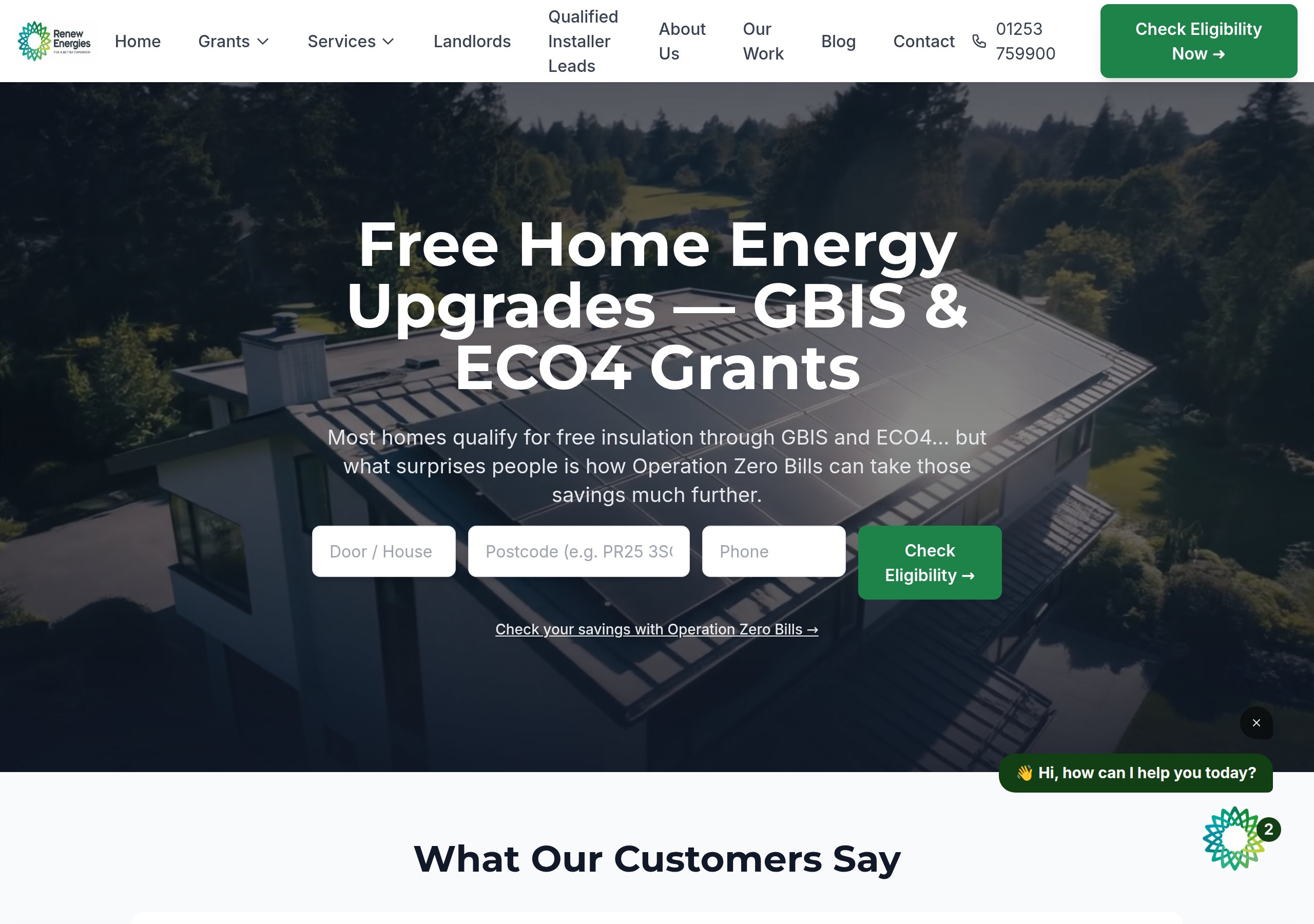
A continuous engineering retainer covering a full bespoke CRM ecosystem, the public website (renewenergiesltd.co.uk), and ongoing AI-agent operations for a UK solar installer. Speed-to-lead engine auto-qualifies and dispatches inbound enquiries in seconds; the field survey app syncs images in real time; an AI agent on the website qualifies visitors directly into structured CRM leads; the social-posting agent drafts completed-job posts for one-click publish. Not a one-off build — a system that keeps moving with the business.
The bottleneck
Renew Energies installs solar, batteries, and renewable heating across the North West of England. Volume is high — the company's published track record sits at 2,000+ completed installations — but the operational stack had grown into a familiar mess: a generic CRM that didn't understand the sales motion, a separate survey-booking tool, a third tool for site photos, a fourth for social media, and spreadsheets gluing the gaps.
The cost was leaking everywhere: leads waited because the CRM didn't know which were grant-eligible; surveyors got back to the office before their photos did; social posts didn't go up because nobody had time to draft them; the website was a static brochure that turned visitors away rather than capture them.
Off-the-shelf solar-installer CRM products exist, but each fixes one slice of this and forces the operation to bend around the vendor's shape — and none combines a public website, speed-to-lead, mobile survey, image sync, AI website qualification, and social posting in one product.
What I built
One bespoke ecosystem, shaped around how Renew Energies actually operates — built and operated under an ongoing engineering retainer.
- The public website. renewenergiesltd.co.uk built end-to-end. Not a separate marketing site bolted on — the same codebase serves the public face, the AI conversational agent, and the CRM intake. Visitors flow into structured leads in one motion.
- The CRM. Pipeline stages that match the real installer sales motion (enquiry → qualified → surveyed → quoted → signed → installed → signed off → reviewed). Fields that capture what the field team actually cares about — postcode, roof orientation, grant eligibility, current heating, MCS-relevant constraints — not the vendor's defaults.
- Speed-to-lead engine. Inbound enquiries get auto-qualified against EPC band, grant eligibility, and property type the moment they land. Personalised response fires within seconds. Qualified leads route directly to the right surveyor.
- Mobile survey app. A bespoke field-team app built around the survey workflow. Photos sync from the van to the CRM in real time, indexed against the customer record. The office side of the build has the full image set before the surveyor is back at the office.
- AI website agent. A conversational agent on the public site that qualifies visitors via real questions (property type, current heating, postcode, what they're considering) and writes them into the CRM as structured leads — not a chat widget that just collects an email.
- Social-posting agent. Signed-off jobs (with photos and customer consent) auto-draft social posts in the company's brand voice. The operator reviews / edits / publishes in minutes. Volume that used to consume a half-day per week becomes a few minutes of approval.
- EPC integration. Auto-check at the moment of enquiry, surfacing grant eligibility in the same response that gets sent to the buyer. No more "we'll get back to you about the £7,500 grant".
- SMS survey booking with proximity routing. When a lead clears pre-qualification, a cron job finds the optimal survey slot using the Haversine distance formula — clustering the new appointment within 15km of the surveyor's existing jobs on the same day to minimise travel. An SMS fires automatically: the customer receives a suggested date and time with a one-click confirm link and a reschedule option. If they request a different time, the system calculates alternatives based on proximity to other that-day bookings. Surveyor Matt's end-of-day constraint (Blackpool home base, 60km radius) is respected automatically. No human dispatches the booking.
The retainer is the commercial shape. Renewable energy is a moving target — grant schemes change, regulations shift, new installer methodologies appear. The build keeps moving with the business rather than freezing on the day of delivery.
What changed
- Five tools collapsed into one bespoke ecosystem the team actually uses.
- Public website + CRM + mobile app + AI agents — one codebase, one source of truth.
- Speed-to-lead reduced to seconds on qualified enquiries — auto-qualification + personalised SMS/email in one motion.
- Survey images sync in real time from the van to the CRM, indexed against the matter — quoting starts before the surveyor is back at the office.
- Social posts auto-drafted per signed-off job, with operator approval — volume that used to be a half-day per week becomes a few minutes.
- AI website agent qualifies visitors into structured CRM leads instead of generic form submissions.
- SMS survey booking dispatch. Qualified leads receive an automated SMS with a proximity-optimised survey slot — calculated using the Haversine formula to cluster near existing jobs and minimise surveyor travel. Customer confirms in one click. No human dispatcher needed.
- Continuous improvement. Under the retainer, the system evolves as Renew Energies evolves. New grant schemes get integrated; new sales motions get reflected in the pipeline; the social agent learns new conventions as the brand voice develops.
By the numbers
Commercial shape and operational specifications of the embedded engineering relationship.
Services used in this build
The capability and service pages this engagement delivered against. Use them to scope a similar build for your operation.
AI CRM →
Full bespoke CRM ecosystem — five SaaS tools collapsed into one operator-shaped system.
Voice Agents →
Speed-to-lead engine that auto-qualifies and dispatches inbound enquiries in seconds.
AI Customer Service (use case) →
AI website agent qualifying visitors into structured CRM leads, plus social-posting drafted in brand voice.
AI SMS Agents →
Speed-to-lead SMS, proximity-optimised survey booking dispatch, and two-way qualification over plain text.
AI Systems Integration →
Mobile field-survey, EPC checks at enquiry time, social syndication — one bespoke spine, no SaaS sprawl.
Questions about this build
A monthly retainer covers the build, the public website, ongoing engineering, and the operational AI agents. It is a continuous engineering relationship rather than a one-time build — closer to having an embedded engineering capability than to commissioning a project and walking away.
Because renewable energy is a moving target — grant schemes change, regulations shift, new installer methodologies appear. A retainer means the build keeps moving with the business rather than freezing on the day of delivery.
Because the renewables-installer sales motion does not fit the off-the-shelf shape. A solar lead is qualified differently from a typical MQL: postcode-based grant eligibility, current heating system, roof orientation, planning constraints, and EPC band all matter. None of those map cleanly into HubSpot deal stages. Forcing them in produces a CRM that the field team ignores and a sales team that keeps the real pipeline in spreadsheets.
When a homeowner enquires — usually via the website or a paid ad — the first installer to call back wins the survey. Industry data is consistent across services: response inside the first 5 minutes correlates with massively higher conversion. The Renew Energies CRM picks up the enquiry, auto-qualifies it (postcode, property type, grant eligibility, heating system), and dispatches a personalised response within seconds, then routes the qualified lead to the right surveyor.
The field surveyor uses a custom mobile app on a tablet — built around the actual survey workflow Renew Energies runs in the field, not a generic forms app. Photos taken during the survey (roof, electrics, meter cabinet, before/after, etc.) are uploaded in real time, indexed against the matter, and processed automatically. By the time the surveyor is back in the van, the CRM already has the full image set, geo-tagged, attached to the customer record, and ready for quoting.
Once a job is signed off in the CRM (with photo evidence and customer consent), the agent drafts a social post: location, type of install, headline outcome, and a tagged image. The post goes into a pending-review queue; the operator approves or edits before it publishes to Facebook, LinkedIn, and (where active) Instagram. The brand voice is trained on the company's historical posts. Volume that used to take a half-day per week now takes minutes of review.
The agent on renewenergiesltd.co.uk qualifies visitors in conversation rather than via a static form. It asks about property type, current heating, postcode, and what they're considering. Qualified leads are written into the CRM as structured records, ready for the speed-to-lead engine to act on. Unqualified visitors are pointed to useful information instead of being added to the pipeline. The website itself was built end-to-end as part of the engagement — public site, conversion agent, CRM intake, all one ecosystem.
Still have a question? Book a discovery call — direct line to me, Dean.
Other industries I've built for
Different operations, same engineering discipline.
Want a build like this for your operation?
Every build starts with a discovery call. Map your bottlenecks. Get a costed bottleneck map — whether we build or not.
Book a Discovery Call