Counselling in the Community: a bespoke booking and member platform for a King's Award charity
A bespoke Next.js platform for Counselling in the Community, a King's Award-recognised UK counselling charity. Public marketing pages route visitors by need (help-to-help, give, volunteer) rather than dropping them on a generic homepage. A three-step intake flow guides new clients into the service; an authenticated member area supports ongoing relationships; staff coordination tools live behind auth.
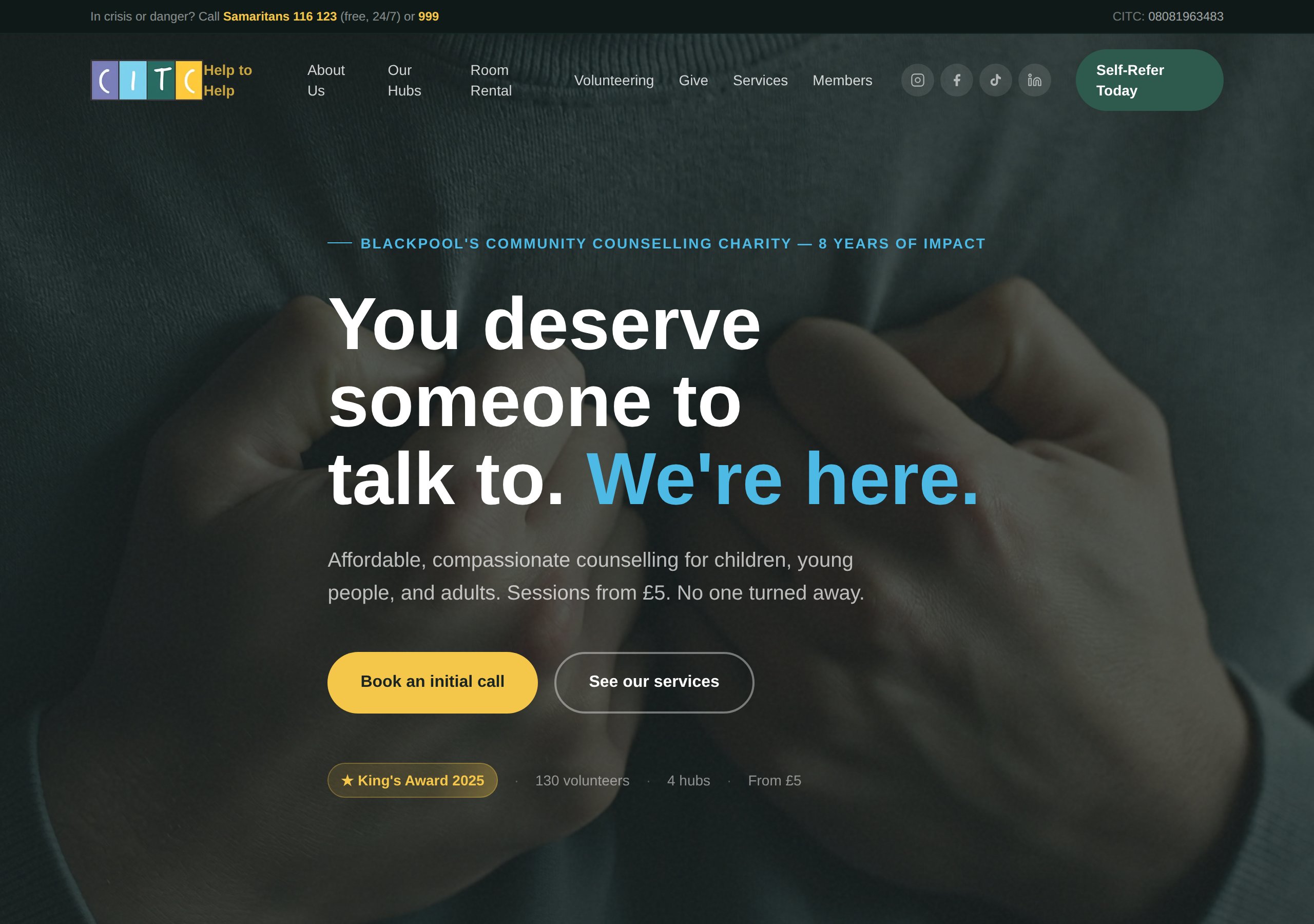
Labels distinguish client facts, reported results, comparisons and delivered system capabilities.
The bottleneck
A community counselling charity was running on a site that didn\'t reflect the depth of the actual service. A structured intake (brief assessment call → start sessions), multiple hub locations, a volunteer programme, donation flows, staff coordination, an authenticated area for active clients, and the King\'s Award credibility anchor, all flattened into a generic three-page brochure.
The off-the-shelf option for charity sites assumes one button (donate) and a couple of about pages. CITC operates as a structured service with multiple audiences (new clients, active clients, staff, volunteers, donors), and a website that doesn\'t separate those journeys forces every visitor through the same funnel and loses most of them.
What I built
A bespoke Next.js site with discrete surfaces for each audience:
- Public marketing pages. About, our hubs, King\'s Award, staff, kings-award honour surfaced on every page as a credibility anchor.
- Structured intake flow. Three explicit steps: Get in touch (initial enquiry capture), Brief assessment call (triages need and matches counselling pathway), Start your sessions (onboarded into ongoing service). Each step is its own surface; visitors are routed rather than left to navigate.
- Authenticated member area. Active clients log in to access content and communication relevant to their counselling relationship. Supabase handles auth and role-scoped access.
- Volunteer and giving flows. Their own paths, with copy and CTAs tuned to each audience rather than competing for attention on the homepage.
- SMS qualification agent "Sarah". When a visitor submits the contact form, a Postgres AFTER INSERT trigger fires the
sms-startedge function, which sends the first message from Sarah (Twilio +447380698199) within seconds, regardless of whether anyone is at a desk. Sarah conducts a two-way qualification conversation over plain SMS: Claude Sonnet 4.6 generates each contextually aware reply, maintaining the full conversation history as memory. When the conversation reaches a defined endpoint, Claude Haiku extracts an 11-point qualification checklist: what the person needs, which counselling pathway fits, urgency, relevant constraints, into structured JSON stored insms_conversations.qualification. Staff open the enquiry in the/staff/enquiriesdashboard and see the completed checklist alongside the full transcript, before they have made any contact themselves. A person in need hears from the charity within seconds, not days. - Staff coordination tools. Behind auth, distinct from the public surface.
What changed
A site that matches the operational complexity of the charity rather than flattening it. Visitors are routed by need at the front door (help-to-help vs. give vs. volunteer) and each journey is its own designed surface. The King\'s Award sits on every page as the dominant trust signal, a visitor who needs counselling sees recognised standing before they\'re asked to share anything personal.
Services used in this build
The capability and service pages this engagement delivered against. Use them to scope a similar build for your operation.
AI SMS Agents →
Sarah, the two-way Claude-driven SMS qualification agent that contacts enquirers within seconds and extracts a structured 11-point checklist before staff make first contact.
AI Apps & Websites →
The bespoke charity site shaped around how the community service actually delivers its programmes.
AI Implementation →
The full implementation pillar, discovery-led bespoke builds with code-ownership.
Questions about this build
Charity templates assume the standard shape: about us, donate, contact. CITC operates as a structured service: a brief assessment call, then ongoing counselling sessions, with multiple hub locations, a volunteer programme, a member area for active clients, staff coordination behind auth, and a King's Award to surface. A template flattens all of that into "click to donate". A bespoke build matches the real operational shape of the charity.
A visitor seeking help follows a three-step path: (1) Get in touch, initial enquiry capture; (2) Brief assessment call, a short, structured conversation that triages need and matches the right counselling pathway; (3) Start your sessions, onboarded into the ongoing service. Each step is its own surface; transitions are designed rather than left to the visitor to navigate.
Active clients log in to access content, communication, and information relevant to their ongoing counselling relationship, kept distinct from the public marketing pages. Staff also have an authenticated coordination layer for operations behind the public surface. Supabase handles auth and role-scoped access.
The King's Award for Voluntary Service is the highest honour given to a UK volunteer-led group, the voluntary equivalent of an MBE. Surfacing it on every page is a credibility anchor that signals the charity's standing without forcing the visitor to find an "awards" page. For a service that asks visitors to share vulnerable personal information, that trust signal pays for itself.
Still have a question? Book an Operations Review, direct line to me, Dean.
Other industries I've built for
Different operations, same engineering discipline.
WheelsAI
60-second inbound response, full bespoke DMS, marketplace syndication built in
Renewable energy: solar installerRenew Energies
Embedded engineering retainer: CRM + website + AI agents, one ecosystem
Renewable energy & EPC complianceThermova
Bulk EPC matching in minutes vs. a day per portfolio
Want a build like this for your operation?
Every build starts with an Operations Review. Map your bottlenecks. Get a costed bottleneck map, whether we build or not.
Book an Operations Review