Lyttle's Tiling: a high-conversion trade website for a Lancashire tiling business
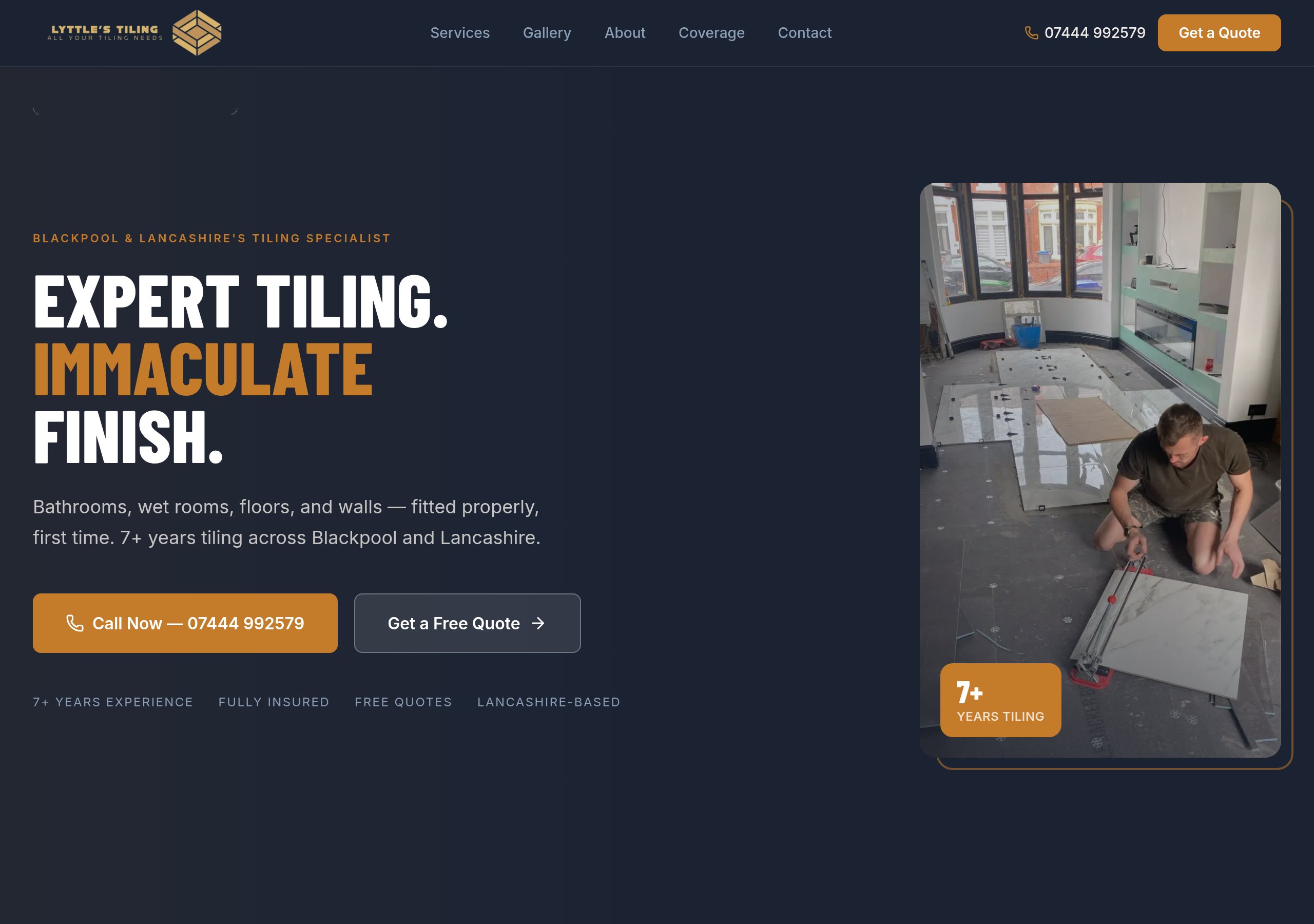
A bespoke Next.js marketing site for a Lancashire tiling business, engineered as a conversion flow rather than a brochure. Hero → Trust → Services → Portfolio → About → Why → Testimonials → Coverage → FAQ → Contact, with the phone number on every section and a quote form on the same page.
Labels distinguish client facts, reported results, comparisons and delivered system capabilities.
The bottleneck
A skilled tradesman with 7+ years of finished tiling work across Blackpool and Lancashire was running the business off Facebook posts and word of mouth. Quote requests arrived as DMs at random hours; the brand looked the same as every other Lancashire tiler running a £29/month template; finished jobs were undocumented as marketing assets.
The constraint wasn't the work, the work was strong. The constraint was packaging that work into a credible lead-capture surface that converts the search-intent traffic Google was already sending.
What I built
A bespoke Next.js site engineered as a conversion flow rather than a brochure. The page sequences buyer psychology deliberately:
- Hero: clear value prop, phone CTA, hero image of recent finished work, headline trust band ("7+ years tiling across Blackpool and Lancashire").
- Trust band: "fully insured, free quotes, Lancashire-based" stripe that costs zero attention but answers three objections.
- Services: bathrooms, wet rooms, floors, walls. One card each, photo of representative job.
- Portfolio: real finished jobs, named where possible.
- About / Why us / Testimonials, the social proof stack, deliberately ordered.
- Coverage, postcodes and towns served. Triple-duty: trust signal, conversion (am I in your area?), local SEO.
- FAQ, pre-emptively neutralises the questions a buyer would otherwise have to phone to ask.
- Contact, quote form on the same page. The phone number again. No separate destination.
What changed
A site that reads like a £20m specialist trade firm, not a £200k owner-operator. The phone number is the dominant CTA, because trade buyers convert by call, not by form. The form catches the leads that prefer typing. The FAQ neutralises common objections before the form does. The coverage section earns local-SEO surface area for postcode-shaped queries.
The site does one job, generate qualified phone calls and qualified quote requests for a Lancashire tiler. It's not trying to be more than that.
Services used in this build
The capability and service pages this engagement delivered against. Use them to scope a similar build for your operation.
AI Apps & Websites →
The bespoke high-conversion trades site, engineered around the operator workflow.
Voice Agents →
Inbound qualification and booking flow integrated with the field schedule.
AI Appointment Booking (use case) →
Booking flow tuned for trade-business routing, travel-time logic, and reminder sequences.
AI Workflow Automation →
The broader pillar, automating repetitive cognitive work across the trades operation.
Questions about this build
Two reasons. First, every other tradesman in Lancashire is using the same templates, the brand reads as undifferentiated to the buyer at a glance. Second, templates rarely structure the page as a conversion flow; they ship a generic homepage that's pretty but doesn't escalate intent. The bespoke build sequences the page deliberately: trust, services, real portfolio, social proof, coverage, FAQ, contact.
A coverage section that names the postcodes and towns served (Blackpool, Fleetwood, Lytham St Annes, Cleveleys, Lancashire-wide) signals geo-relevance to Google. Combined with structured data, descriptive page metadata, and the 7+ years experience trust anchor, the site competes for "tiler near me" and "bathroom tiling Blackpool" without paying for ads.
The phone number is omnipresent (header, hero, FAQ, footer) because most trade leads convert via call. The quote form lives at the bottom of the same page, no separate /contact destination that loses momentum. Visitors who reach the form have already passed through trust → services → portfolio → testimonials, so the form fills the role of capturing the lead rather than persuading.
Booking calendars and payment processing, these are commodity SaaS and a tradesman this size doesn't need them. The site is engineered to generate the call. Everything after that is the trade relationship, not the website.
Still have a question? Book an Operations Review, direct line to me, Dean.
Other industries I've built for
Different operations, same engineering discipline.
FitLife
Claude-powered diabetes-aware AI fitness platform
Hospitality: direct-booking holiday letStay by the Sea
Direct-booking site engineered to outrank OTAs for a 7-bed Blackpool let
Community & charity: counselling servicesCounselling in the Community
Bespoke intake + member platform for a King's Award charity
Want a build like this for your operation?
Every build starts with an Operations Review. Map your bottlenecks. Get a costed bottleneck map, whether we build or not.
Book an Operations Review